The Gift of a Brother
04/29/17 | Women's Soccer
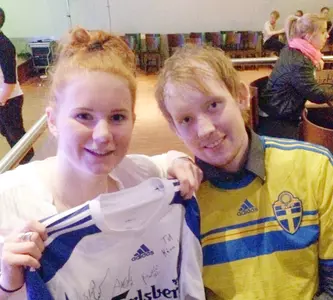
Oregon soccer's Halla Hinriksdottir is a part of the inaugural St. Baldrick's Foundation Baldfest to take place on Sunday April 30. Her connection to the cause is personal, as she recently lost her brother to cancer. She seeks refuge with her Duck teammates, who have helped her cope from being nearly 4,000 miles away from her family.
Oregon soccer's Halla Hinriksdottir's love for the game of soccer stemmed from her love for her older brother.
Kári Örn Hinriksson played soccer while the two grew up in Iceland. Kári loved the game of soccer, and was Halla's role model growing up.
"I started playing soccer because I wanted to be like him," Halla said. "He had some hip problems so he had to transition from being a forward to being a goalkeeper, so I wanted to be a goalkeeper too. I showed up to my first practice and I was like, 'I want to be the goalkeeper.'"
As a child, Kári read a book to Halla about English soccer player Wayne Rooney, who still plays for Halla and Kári's favorite team, Manchester United.
"I was too young to read a book in English myself so every night we would sit on the couch or lay in bed and he would read it and translate everything from English to Icelandic," Halla recalled. "We were just really good friends, we enjoyed the banter."
At age 11, Halla tried out the goalkeeper position for the first time, thanks to her brother Kári.
"We were at our grandparents house and they have a lot of trees in their backyard and we were playing soccer and he told me to go in goal because he was practicing his shooting," Halla said. "After shooting at me for maybe an hour he was like, 'maybe you should actually try and play soccer and be a goalkeeper.'"
Just before Halla's 12th birthday, everything changed.
Kári, age 17 at the time, was diagnosed with cancer. He had lymphoma in the back of his nose, prompting chemotherapy and radiation to begin his treatment.
"When you're a kid you hear the word cancer thrown around and you don't really think about what it [is].
"I kind of grew up in a hospital for that part of my life from 11 to 15. Every day it would be a routine. I would go to school and either one of my parents would pick me up and go to the hospital and I would stay there until it was bed time. One of them would stay in the hospital and the other one would take me back and we would do it all over again. That would be the case for a good year on and off."
Kári's time in the hospital not only flipped his world around but also that of his family, including Halla.
"You go from not having a care in the world being an 11-year-old. Your biggest issue is like what t-shirt to wear to school or if you're popular enough. It went from that to going to school and thinking the whole day what he would be doing in the hospital, how he was doing and how his last night was. We had a lot of people who were asking about him. There was a little disconnect between you and your friends because they don't really know what's going on."
It was a major change to everyday life for Halla and her family. With their new routine, Halla's family had to get used to a different lifestyle, and for Halla, it even meant a halt in her young soccer career.
"We were fortunate enough that we got to spend Christmas at home," Halla said. "At the time, I had to give up soccer for a little bit. I wouldn't want to go from the school to the hospital to practice and back to the hospital. I wanted to spend time there and spend time with him."
When Kári would begin to do better, a sense of normality would come back the family. Halla would begin to go to school and soccer practice again but she knew that could change in an instance.
"Uncertainty became normal to us. We didn't know if we were going to be able to have Christmas together or travel as a family. It was just so many years we spent in the hospital, it became our normal."
Kári was able to take tests and do homework while he was getting treatment at the hospital, and he never fell too far behind other students his age.
"He graduated on time, which was amazing. He was about 20 and he was graduating from the commercial college that I went to. He was completely bald and so skinny and barely able to stand but he actually made it to graduation and got an award from the principal."
The impact of Kári's hospitalization isolated Halla from her friends, and forced her to act like an adult at a young age.
"You get pretty lonely because my friends got to go home and play or go to practice or play video games and I drove to the hospital...It was a lot of growing up and maturing...I kind of felt left out when I was with my friends because they didn't really get it or get what was going on. We didn't talk about it. The few times that people would ask me like teachers or parents I would just say things were going good, even when they weren't."
When Halla was in seventh grade, the idea of playing collegiate soccer came about, which was not available in Iceland. She pursued college soccer at the University of Oregon, nearly 4,000 miles away.
"I love traveling and I just thought it would be a fun adventure to go somewhere else where you don't know anyone else and learn how to play a different style of soccer. A lot of Icelandic athletes want to go to the States to play. I originally wanted to go for a year, because I didn't want to take away time with my brother. His health was really good when I left. He had been cleared. He had a job, an apartment, got married when I left so I didn't feel bad about leaving."
Halla, now in her junior year, chose to stay longer at Oregon after she felt she had unfinished business following her first year with the Ducks.
"I think he wanted me to go do what I wanted to do. He kind of felt bad that I put my childhood on hold and putting soccer on hold just to be with him in the hospital. He just wanted me to go have fun and go live life while I can. I heard he was proud of me, which made me so happy."
Halla even earned national team call-ups, including playing for the U-19 team in the 2012 European Championships.
"When I started playing for the national team I remember being so excited, not because I was picked on the national team but because I thought he would be actually proud of me for that."
In the winter term of Halla's sophomore year at Oregon, Kári, age 27, died. His immune system was incredibly suppressed and he got sick, which made his blood get infected and subsequently, his heart stopped.
Her parents came to Eugene to visit her after Kári's death and they concluded that she should continue to study and play soccer at Oregon.
"I don't know how they're doing it right now. It's easier for me to heal from his death because I'm here (Eugene) not home where everything reminds me of him."
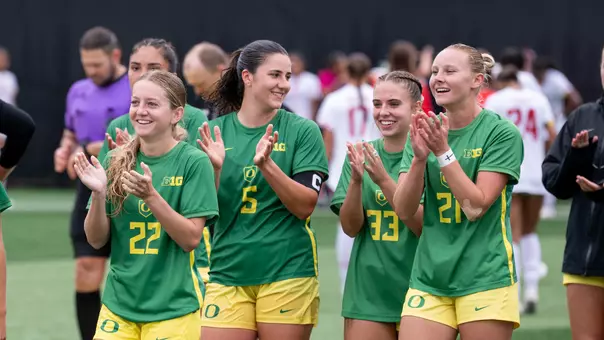
Halla also had second family in Eugene: the Oregon soccer team, which helped her get through the difficult time.
Though she was close with her teammates, Halla did not tell them about Kári's illnesses. The coaches and her roommates were the only members of the team who knew. Death is not easy to deal with, but Halla said that her teammates were positive and loving around her, which was healing in itself.
Halla learned a lot from her brother, but she did learn one specific lesson.
"If I were to boil it down: How precious life is, and how we should treat it as such."
Now, Halla is a part of the inaugural St. Baldrick's Foundation Baldfest, which the Oregon soccer team has worked since January. On Sunday April 30 at Papé Field, the soccer team will be shaving the heads of volunteers, including Oregon Athletic Director Rob Mullens and former Oregon three-sport athlete and current softball and soccer stadium announcer Peg Reese.
Halla, along with her teammates and fellow Oregon student athletes and students, have been raising money for St. Baldricks, a non-profit organization that helps raise money for childhood cancer. As of Friday April 28, the group of athletes and students have raised $27,684, surpassing their initial goal of $20,000.
Halla, like many of the volunteers, has been impacted by cancer and the disease has changed her life forever. Although she cannot bring her brother back, she and the rest of the UO St. Baldrick's group are doing their part to make sure no family has to deal with their child being lost to cancer.

Kári Örn Hinriksson played soccer while the two grew up in Iceland. Kári loved the game of soccer, and was Halla's role model growing up.
"I started playing soccer because I wanted to be like him," Halla said. "He had some hip problems so he had to transition from being a forward to being a goalkeeper, so I wanted to be a goalkeeper too. I showed up to my first practice and I was like, 'I want to be the goalkeeper.'"
As a child, Kári read a book to Halla about English soccer player Wayne Rooney, who still plays for Halla and Kári's favorite team, Manchester United.
"I was too young to read a book in English myself so every night we would sit on the couch or lay in bed and he would read it and translate everything from English to Icelandic," Halla recalled. "We were just really good friends, we enjoyed the banter."
At age 11, Halla tried out the goalkeeper position for the first time, thanks to her brother Kári.
"We were at our grandparents house and they have a lot of trees in their backyard and we were playing soccer and he told me to go in goal because he was practicing his shooting," Halla said. "After shooting at me for maybe an hour he was like, 'maybe you should actually try and play soccer and be a goalkeeper.'"
Just before Halla's 12th birthday, everything changed.
Kári, age 17 at the time, was diagnosed with cancer. He had lymphoma in the back of his nose, prompting chemotherapy and radiation to begin his treatment.
"When you're a kid you hear the word cancer thrown around and you don't really think about what it [is].
"I kind of grew up in a hospital for that part of my life from 11 to 15. Every day it would be a routine. I would go to school and either one of my parents would pick me up and go to the hospital and I would stay there until it was bed time. One of them would stay in the hospital and the other one would take me back and we would do it all over again. That would be the case for a good year on and off."
Kári's time in the hospital not only flipped his world around but also that of his family, including Halla.
"You go from not having a care in the world being an 11-year-old. Your biggest issue is like what t-shirt to wear to school or if you're popular enough. It went from that to going to school and thinking the whole day what he would be doing in the hospital, how he was doing and how his last night was. We had a lot of people who were asking about him. There was a little disconnect between you and your friends because they don't really know what's going on."
It was a major change to everyday life for Halla and her family. With their new routine, Halla's family had to get used to a different lifestyle, and for Halla, it even meant a halt in her young soccer career.
"We were fortunate enough that we got to spend Christmas at home," Halla said. "At the time, I had to give up soccer for a little bit. I wouldn't want to go from the school to the hospital to practice and back to the hospital. I wanted to spend time there and spend time with him."
When Kári would begin to do better, a sense of normality would come back the family. Halla would begin to go to school and soccer practice again but she knew that could change in an instance.
"Uncertainty became normal to us. We didn't know if we were going to be able to have Christmas together or travel as a family. It was just so many years we spent in the hospital, it became our normal."
Kári was able to take tests and do homework while he was getting treatment at the hospital, and he never fell too far behind other students his age.
"He graduated on time, which was amazing. He was about 20 and he was graduating from the commercial college that I went to. He was completely bald and so skinny and barely able to stand but he actually made it to graduation and got an award from the principal."
The impact of Kári's hospitalization isolated Halla from her friends, and forced her to act like an adult at a young age.
"You get pretty lonely because my friends got to go home and play or go to practice or play video games and I drove to the hospital...It was a lot of growing up and maturing...I kind of felt left out when I was with my friends because they didn't really get it or get what was going on. We didn't talk about it. The few times that people would ask me like teachers or parents I would just say things were going good, even when they weren't."
When Halla was in seventh grade, the idea of playing collegiate soccer came about, which was not available in Iceland. She pursued college soccer at the University of Oregon, nearly 4,000 miles away.
"I love traveling and I just thought it would be a fun adventure to go somewhere else where you don't know anyone else and learn how to play a different style of soccer. A lot of Icelandic athletes want to go to the States to play. I originally wanted to go for a year, because I didn't want to take away time with my brother. His health was really good when I left. He had been cleared. He had a job, an apartment, got married when I left so I didn't feel bad about leaving."
Halla, now in her junior year, chose to stay longer at Oregon after she felt she had unfinished business following her first year with the Ducks.
"I think he wanted me to go do what I wanted to do. He kind of felt bad that I put my childhood on hold and putting soccer on hold just to be with him in the hospital. He just wanted me to go have fun and go live life while I can. I heard he was proud of me, which made me so happy."
Halla even earned national team call-ups, including playing for the U-19 team in the 2012 European Championships.
"When I started playing for the national team I remember being so excited, not because I was picked on the national team but because I thought he would be actually proud of me for that."
In the winter term of Halla's sophomore year at Oregon, Kári, age 27, died. His immune system was incredibly suppressed and he got sick, which made his blood get infected and subsequently, his heart stopped.
Her parents came to Eugene to visit her after Kári's death and they concluded that she should continue to study and play soccer at Oregon.
"I don't know how they're doing it right now. It's easier for me to heal from his death because I'm here (Eugene) not home where everything reminds me of him."
Halla also had second family in Eugene: the Oregon soccer team, which helped her get through the difficult time.
Though she was close with her teammates, Halla did not tell them about Kári's illnesses. The coaches and her roommates were the only members of the team who knew. Death is not easy to deal with, but Halla said that her teammates were positive and loving around her, which was healing in itself.
Halla learned a lot from her brother, but she did learn one specific lesson.
"If I were to boil it down: How precious life is, and how we should treat it as such."
Now, Halla is a part of the inaugural St. Baldrick's Foundation Baldfest, which the Oregon soccer team has worked since January. On Sunday April 30 at Papé Field, the soccer team will be shaving the heads of volunteers, including Oregon Athletic Director Rob Mullens and former Oregon three-sport athlete and current softball and soccer stadium announcer Peg Reese.
Halla, along with her teammates and fellow Oregon student athletes and students, have been raising money for St. Baldricks, a non-profit organization that helps raise money for childhood cancer. As of Friday April 28, the group of athletes and students have raised $27,684, surpassing their initial goal of $20,000.
Halla, like many of the volunteers, has been impacted by cancer and the disease has changed her life forever. Although she cannot bring her brother back, she and the rest of the UO St. Baldrick's group are doing their part to make sure no family has to deal with their child being lost to cancer.

Players Mentioned

GK
/ Women's SoccerWednesday, October 07
Wednesday, October 07
Saturday, October 03
Wednesday, September 30